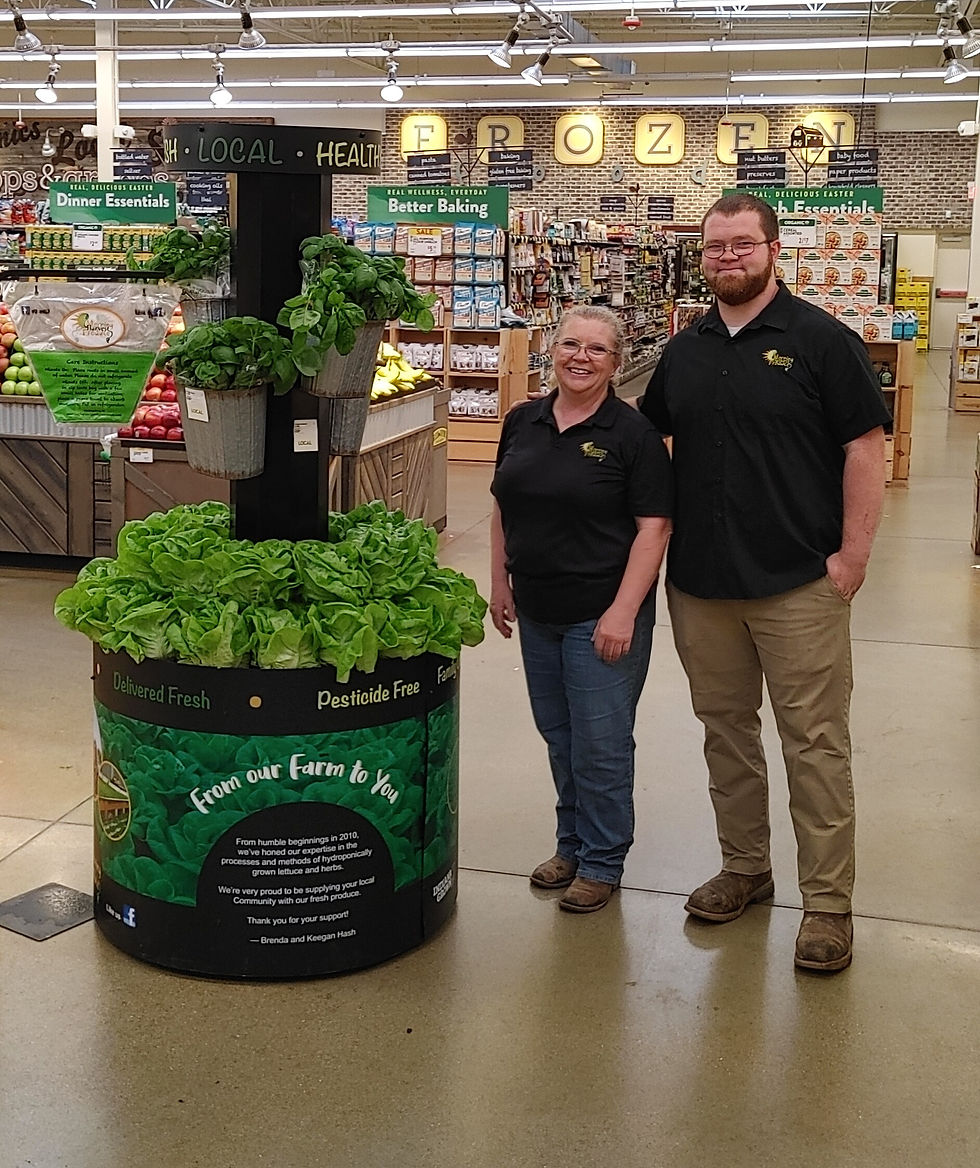
Brenda Hash | Morning Harvest Produce
County: Washington County, Indiana
Years farming: 26
Farm size: 11 acres
Primary products: Hydroponic lettuce, basil and herbs, livestock
Production approach: Hydroponic, organic (not-certified), diversified
Conservation practices in use: rotational grazing, nutrient management planning, hydroponic water conservation

From Sheep to Hydroponics: Brenda Hash’s Path to Innovation
For Brenda Hash, farming has always been about family, learning, and a willingness to try something different.
Having grown up on a farm, it was important to Brenda to give her children the same experience. About 26 years ago, she and her husband started with sheep on their small farm in Washington County. With four young children involved in 4-H, the family raised between 50 and 200 head of sheep over the next 16 years. They chose an uncommon Katahdin hair sheep breed, which meant Brenda and her family had to learn, and teach others, about a different way of raising livestock.
“We had to educate ourselves as well as the public,” she says. “That’s something I’ve always enjoyed—learning something new and sharing it with others.” The family practiced rotational grazing and spent years raising sheep and showing them at the state fair. But as her children grew older and left for college, Brenda began thinking about what might come next. She loved gardening and originally hoped to start a u-pick strawberry operation. When that idea didn’t work out, she started researching alternative ways to grow strawberries—and discovered hydroponics. That research changed everything.
When Brenda began exploring hydroponic growing, her youngest son Keegan was in eighth grade. He immediately became fascinated with the systems and engineering behind it. “He’s always had an engineering mind,” Brenda says. “He loves figuring out how to make things work.” The two began experimenting in their backyard, building small systems and learning as they went. They started with strawberries, then tested lettuce, greens, and herbs. Those crops quickly proved more profitable and easier to scale. “We did a lot of research before we spent any money,” Brenda says. “We built our own systems first just to prove to ourselves that it would work.”
Their experiments eventually became Morning Harvest Produce, which officially launched in 2010 when they built their first greenhouse. Today, the operation has grown far beyond those backyard trials. Brenda and Keegan now operate multiple greenhouses and growing systems, employ five full-time and six part-time staff, supply 82 retail stores, and work with four school districts. Their primary crops include Bibb lettuce, basil, and fresh herbs such as mint, thyme, dill, and chives. The farm currently plants 5,500 heads of butter lettuce and 5,600 heads of leaf lettuce each week plus producing 3,500 packages of basil.
Unlike traditional farms, Morning Harvest Produce grows entirely in water. Their hydroponic system uses floating beds containing nutrient-rich water that recirculates through the system. “We have about 50 grow beds, each with around 1,000 gallons of water,” Brenda explains. “We add a little fresh water each day, and most of it can be reused.” The system produces an impressive amount of food in a relatively small space. Brenda says some have estimated that the farm’s output is comparable to that of a 700-acre row crop farm, even though the actual growing area is only a fraction of that. “We’re producing several crops every six weeks, all under one roof,” she says.
This efficiency also supports conservation goals. Hydroponic growing uses less land and allows water to be reused throughout the production cycle. The farm also follows organic growing practices, avoiding synthetic chemicals even though the operation is not certified organic. “That was important to me,” Brenda says. “I didn’t want to be spraying chemicals on something people are eating.”
Building the farm required more than experimentation—it required learning entirely new skills. Brenda laughs when she talks about some of the things she had to figure out along the way. “I had to learn how to drive a skid steer and do things I’d never done before,” she says. “My philosophy was, if he’s out there doing it, I should be out there doing it too.” Keegan designed and built many of the farm’s systems himself, including electrical and plumbing components. The close working relationship between mother and son has been a defining part of the farm’s journey. “We’re very close, but it can be interesting sometimes,” Brenda says with a smile. “We do butt heads occasionally. But we always come back together because we’re working toward the same goal.”
As a woman farmer operating an unconventional agricultural business, Brenda encountered skepticism early on. “Absolutely there were barriers,” she says. “Not just because I’m a woman, but because we were doing something different.” One early challenge came when Keegan tried to secure a youth agricultural loan through an FFA program to expand their hydroponic project. The request was denied—not for financial reasons, but because the lender didn’t believe hydroponic strawberries would taste good. “It upset me because we were already growing them and knew they were good,” Brenda says. Instead of giving up, Brenda and Keegan decided to move forward on their own. “We said we’ll just do it ourselves and show them.”
Over the years, they’ve continued to face challenges securing financing because hydroponic operations don’t always fit traditional agricultural lending models. Brenda believes careful planning has helped the farm succeed. “We always do our homework first,” she says. “We don’t take out loans to try something—we test it first.”
Education has been a recurring theme throughout Brenda’s farming career. When the farm began selling at farmers markets, many customers had never seen Bibb lettuce or living basil plants. Brenda and Keegan spent years introducing shoppers to different varieties and explaining how hydroponic produce is grown. “We had to educate people because they were used to iceberg lettuce,” she says. Even today, she often talks directly with customers when visiting stores that carry their products. “I believe if you have a good product, it sells itself,” she says. Brenda also sees education as essential for reconnecting people with agriculture. “I really think we need to do more to teach kids where food comes from,” she says. “A lot of people just don’t have that connection anymore.”
Morning Harvest Produce also works with schools to provide fresh, locally grown produce. While there can be challenges competing with large government commodity programs, Brenda says schools often discover unexpected benefits from buying local. One district initially estimated it would need 240 heads of lettuce per week. But because the farm’s lettuce stays fresh longer, the school now only needs about 100 heads weekly, significantly reducing waste. “It’s about quality,” Brenda says. “If something lasts longer, you’re not throwing half of it away.”
Brenda encourages women who are interested in farming—especially innovative systems like hydroponics—to start with research and careful planning. “Educate yourself first,” she says. “Do the research before you invest a lot of money.” She also believes growth should follow demand. “Grow as your customer base grows,” she says. “Don’t build huge and then try to find customers.” Brenda and Keegan continue to experiment with new systems and ideas. Their next goal is to build a facility that allows for expanded indoor growing using similar techniques to the container systems they are currently testing. “We’re always looking at ways to improve what we’re doing,” Brenda says. For her, the most rewarding part of the journey is seeing both crops—and people—grow. “I love watching things grow,” she says. “Whether it’s the plants, the sheep we used to raise, or even my kids and grandkids learning alongside me.”
Learn more about Morning Harvest Produce on their website, www.morningharvestproduce.com